
Playing House
Dollhouses as the architecture of imagination

I watched The Housemaid on a red eye to London last week. A suburban family—wealthy, white, and gorgeous—appears perfect from the outside, but behind closed doors, there is enough sex, violence, and scandal to set the neighborhood ablaze. The central tension of the story stems from the dissonance between the perception and reality of their domestic life.
As we reach the climax of the movie, we realize that we have been privy to the fate of Millie, the housemaid (regrettably played by Sydney Sweeney), the entire time. Nine-year-old Cece has warned us, locking a doll that looks like Millie in the attic of her dollhouse.
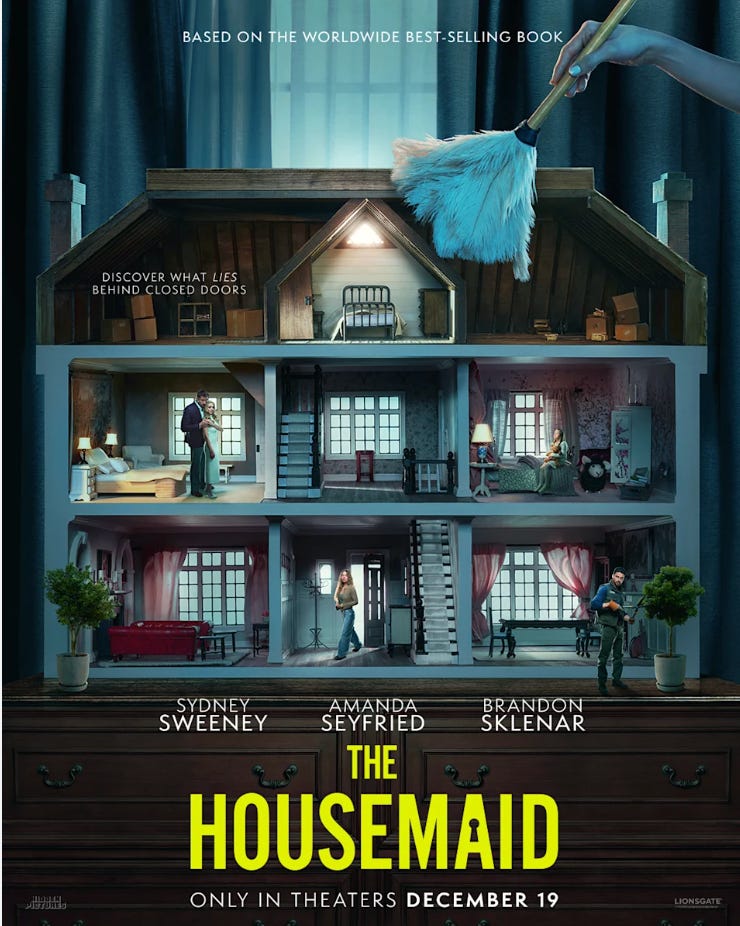
This bread-crumbing has a number of implications, the first being that children often know more than their parents allow themselves to believe. The second is the grip that dollhouses have in our cultural zeitgeist now and across time.
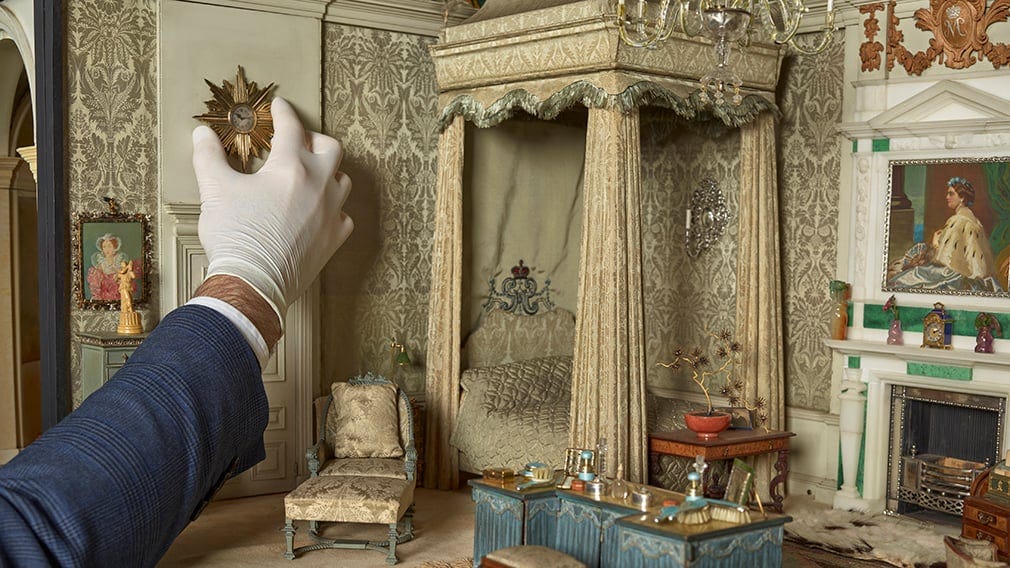
Perhaps the one and a half million visitors who traveled to see the elaborate dollhouses of Queen Mary in 1924 thought that some hidden truth awaited them—insight into the life-sized palace. The glaring irony of this dollhouse, commissioned in the wake of World War One to raise public spirits, is, of course, the contrast between a royal family with the time to amuse themselves with miniatures and a public savaged by the effects of war.
As I watched the horrors of The Housemaid unfold, I couldn’t help but think of Emerald Fennel’s Wuthering Heights adaptation. In Fennel’s version, Isabella Linton plays with a large, matryoshka-style dollhouse of which the residents more closely resemble voodoo dolls than loving playmates. In The Housemaid, Cece’s dollhouse suggests a maturity beyond that of a child— ‘play’ functioning as a more accurate depiction of reality. In the latter, Isabella’s games are that of a regression, a way for her to assert control in a house where she has little. Two truths exist: when children play with a dollhouse they engage with the world of the adult: running a household and exerting ultimate control; when adults play with a dollhouse they regress to the simplicity of childhood, escaping to fantasy ungrounded in reality.


Frances Glessner Lee made meticulous miniature recreations of crime scenes as a way to help solve crimes—most often, brutal domestic murders of women. Analyzing this dollhouse application, Laura Miller writes, “The material culture of the domestic interior provides evidence of how its occupants wish to be recognized. Tightly scripted narratives of self and family are rehearsed ad nauseam until they are naturalized, aided and abetted by artifacts and decor that codify and embellish not only the domestic setting, but also more significantly, the stories being told.” Lee’s work is quite reminiscent of that of Cece in The Housemaid—“While domestic violence is a transgressive act, its presence within the home is not a transgression, then, but an opportunistic exploitation of domesticity’s most pervasive and damaging conceit.” The safety that the home provides as a shield from the outside world is also the greatest threat.
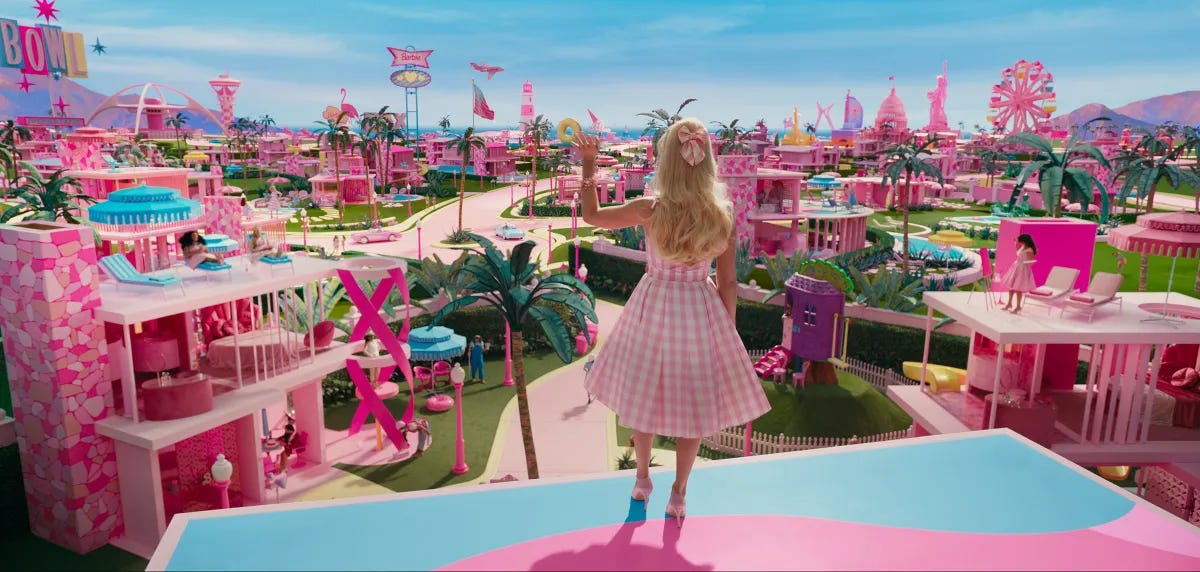
There is something about swinging a dollhouse open, looking at a house in full, that feels novel and intimate. Dollhouses are not only smaller versions of homes, but also a mirror of the limitations and context in which the larger house operates. I won’t tackle the Barbie-of-it-all, but we need only compare Barbie’s Dream House to Ken’s Mojo Dojo Casa House to see how societal norms alter the physical landscape.
As a child, I always hoped I would have the dollhouse at the public library to myself on our visits. It bothered me when other children moved dolls from the kitchen to the attic without using the stairs. The first thing I did upon arrival was reset, removing the watering can from the bathtub and returning it to the garden; resetting the kitchen table, locating forks and knives that were strewn across the house; tying the tiny aprons back onto the dolls. I couldn’t understand what heathens of children would leave a home in such disarray. Undoubtedly, my rigidity made me less fun to play with, an early sign of my own proclivity for order that remains with me.
I also remember playing at the house of a neighbor as a child. On the landing of the front set of stairs was a very large and stately dollhouse. For some reason, in my memory, I was always playing with this dollhouse in the dark. I am not sure why—perhaps I was dropped there in the afternoons when the sun did not reach that corner of the house or was unsure where the light switch was. Either way, I had been told this dollhouse belonged to their eldest daughter, who was now grown up, and was very precious. I do not know if I was allowed to play with it, but I remember sitting in front of it and swinging open the blue exterior by its delicate gold hinges and thinking I had never seen something so beautiful.


In Life Meets Art: Inside the Homes of the World’s Most Creative People, Beatrix Potter is described as viewing her home as “a life-size dollhouse, a place all to herself to write and escape from her life at Castle Cottage, the home across the road that she and her husband, William Heelis, later purchased in 1913.” In Potter’s model, we have three homes: 1) the physical home that we live in and associate with the constriction of reality; 2) a dollhouse that lives in our minds and is associated with the freedoms of play; 3) an additional physical home built in the likeness of the second imaginary dollhouse home. The third house is the inversion: instead of the dollhouse coming into existence as a result of the real house, modeled to match, it is the real house that is modeled from a dollhouse that exists only in our mind.
Perhaps the master of such explorations, illustrating the dollhouse in all of it’s possibilities and limitations, is Taylor Swift. Swift famously employs the dollhouse as a symbol and framework to organize her extensive discography of characters, storylines, and invisible strings.
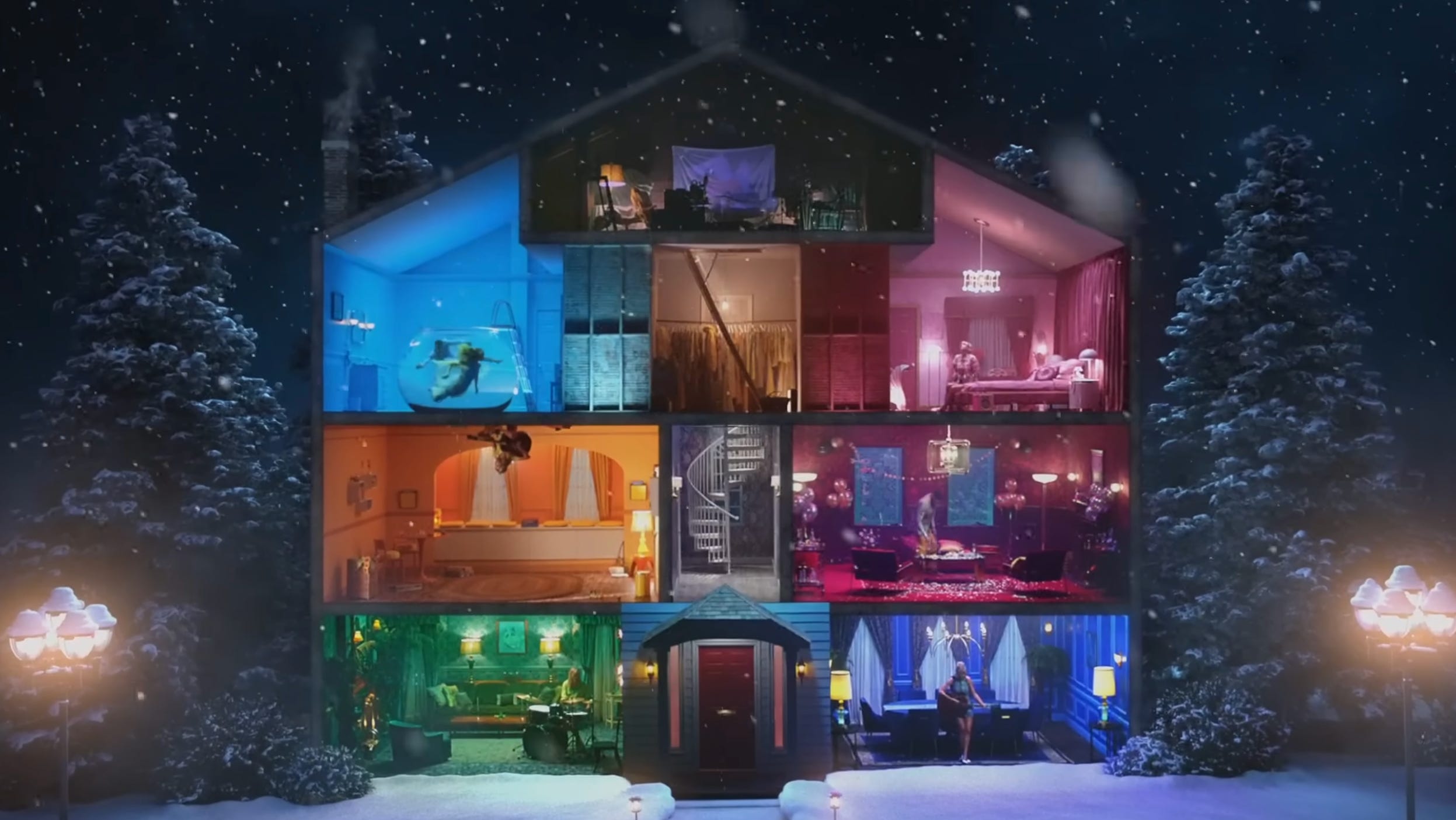
In this house and in real life, Swift is writer, director, singer, producer, and star. Simultaneously, she is controlled by societal pressures—press, patriarchy, politics. She is puppet and puppeteer.
Swift reigns over her world as a child would at play. She is a chameleon, trying on characters like her younger self might have imagined herself to be—a teacher, only child, astronaut, heiress, criminal on the run—when she grew up. It recalls a child instructing their playmate, “now the bride gets left at the altar,” or “now pretend you lost your tongue, and I am the only one who can talk”, or “now we switch, and I am the orphan in a dress of rags, and you are the cruel stepmother”, or “now you open that trap door, and it leads to the Pacific Ocean.” In Swift’s world, she can swim in martini glasses, move through time, break down the walls of her house completely, and float in galactic anti-gravity. She is blonde, brunette, red-headed; a child, an old woman; a monster, an angel—all in the span of three minutes and thirty seconds. She steps into Jane Austen novels, famous oil paintings, and classic movies. One moment she is a widowed heiress on the rocky cliffs of Newport. The next she is in love with the likes of the prince, Scott Eastwood, the football captain, Post Malone, the boy next door.
A whole different can of worms, but I cannot resist highlighting how fascinating it is how literally the Kanye West, 2016 ‘Famous’ music video scandal fits within this context. The vulgar depiction of a naked, doll-like version of Swift both directly confirms the confinement of the dollhouse analogy and grotesquely contrasts the beautiful universe designed and chosen by Swift.
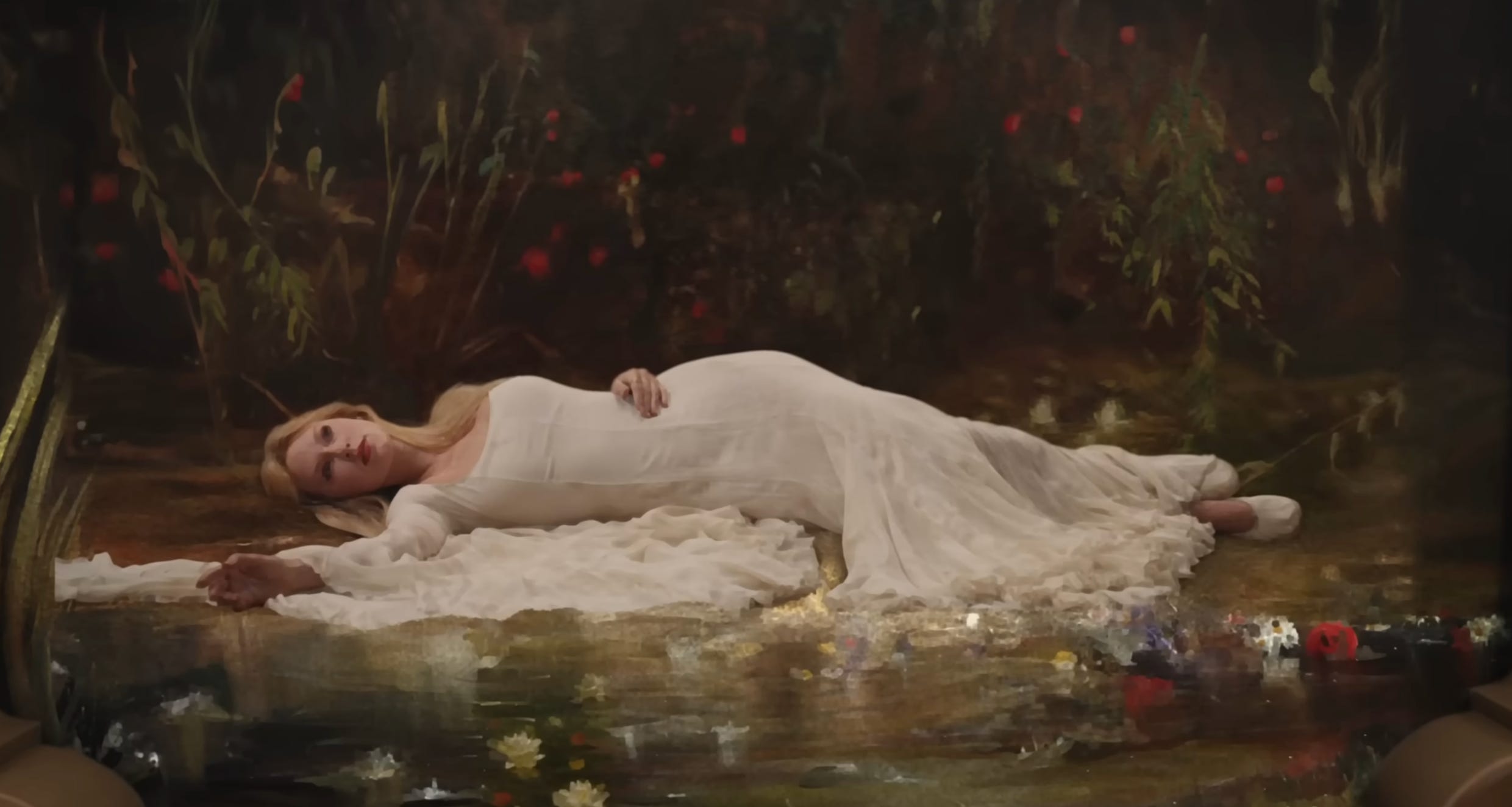
Within the dollhouse architecture lives a myriad of fascinating contradictions: control and freedom, exterior and interior, large and small, real and unreal. The dollhouse is both a product of whimsy—toothpick fences and calico curtains, popsicle stick shingles, and fairy-sized teacups—and an extension of convention and exercise of control—literally constrained by three walls. The fourth wall, of course, removed to allow us in to meddle, pushing the bounds of how we imagine ourselves.
Such an interesting topic! Great piece